A Favorite Scapegoat: Photo Traffic Enforcement
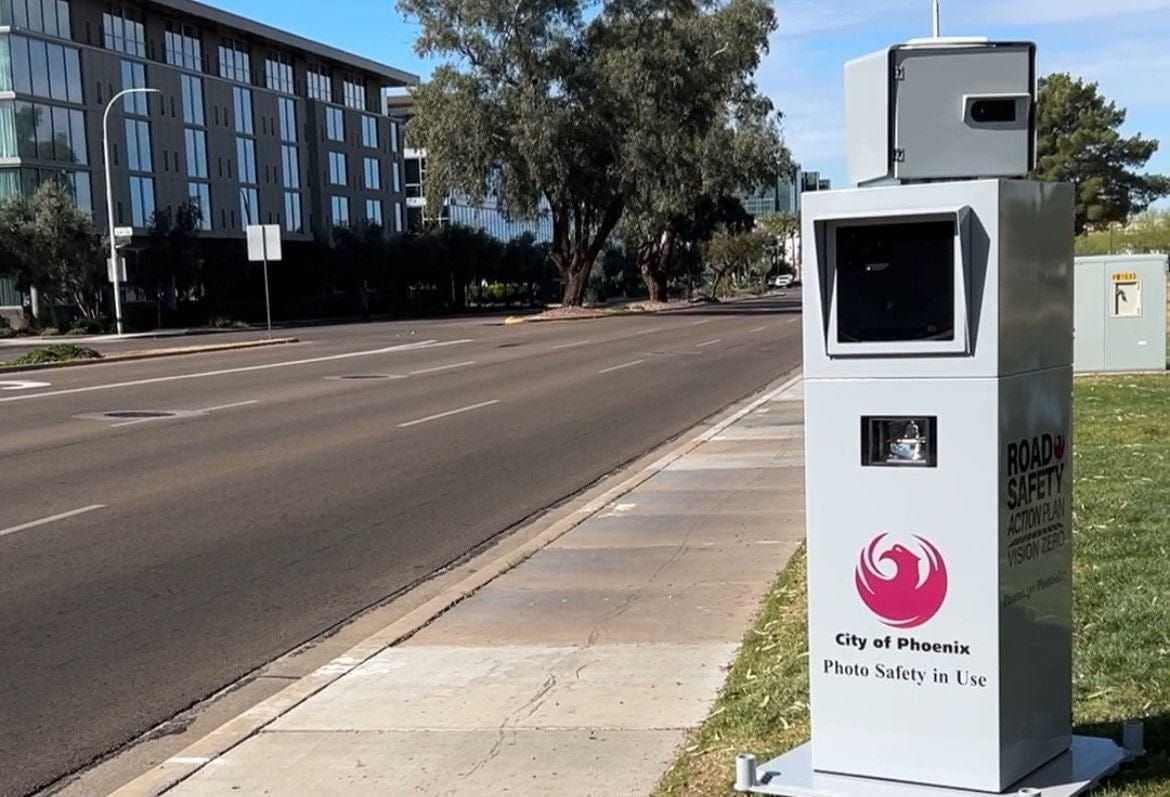
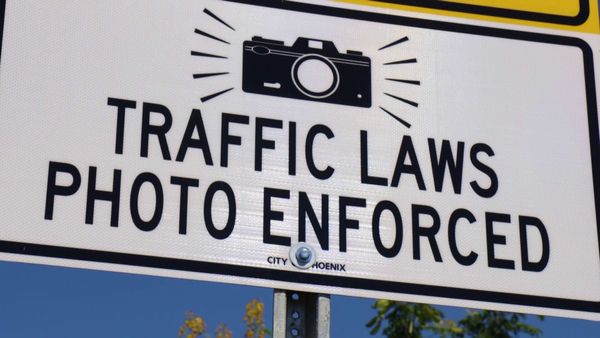
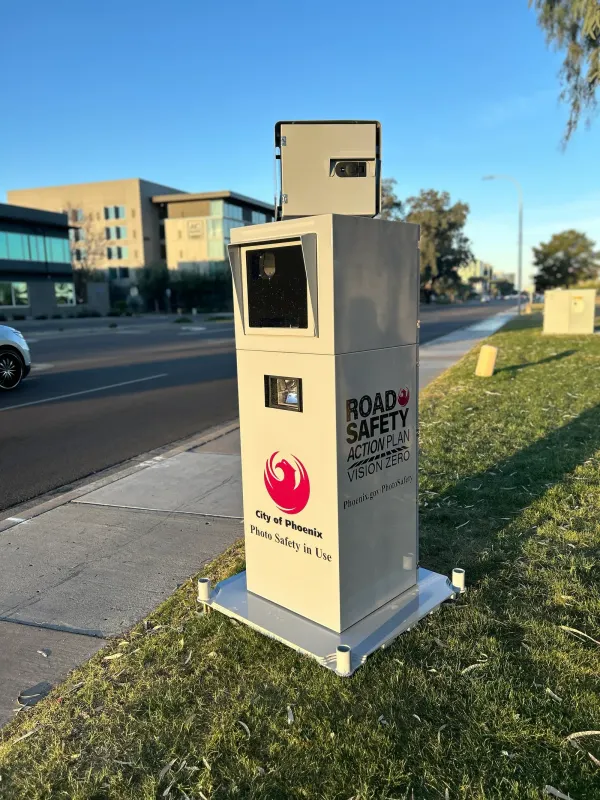
In February 2026, the City of Phoenix deployed 17 photo traffic enforcement systems. Nine of these systems will be rotated through corridors with histories of speed-involved crashes and rotated every six months. Another eight systems will be placed along 15 mph school zones, rotated weekly throughout the year.
If you've lived in the City of Phoenix long enough, you will recall that photo enforcement systems were used in the early 2000s—primarily focused on red light running violations—this is not the same program. This 2026 program has been developed in accordance with best practices described in a Governors Highway Safety Association (GHSA) report, "Automated Enforcement in a New Era".
TL;dr (the bullet points)
- Photo safety systems (aka photo traffic enforcement) do reduce fatalities and serious injuries related to traffic violations.
- Traffic crashes cost society enormous sums in money and human lives.
- Citations aren't "fees"—they are fines—penalties designed to deter violations. The amount of the fine is not based on what a violator can afford, or a sum that "sounds reasonable"—the amount is intended to discourage drivers from violating traffic laws.
- Photo safety systems cost significantly less to operate than traffic enforcement performed by a sworn police officer.
- Data shows that the certainty of being punished is a more effective deterrent than the severity of the punishment. In other words—one reason photo safety systems are effective is that they are a guaranteed punishment for violating traffic laws.
- 11 or more mph is the calibrated threshold for activation of photo safety systems in Phoenix.
- Photo safety systems are regularly calibrated for accuracy.
Popular Myth #1: Revenue generation is the only reason photo enforcement exists
News anchor John Hook recently produced a "Newsmaker" segment for Fox 10 Arizona, stating outright that he is "not a fan" of the systems. He goes on to say:
We're in a grace period right now, but beginning on March 25th, citations will start going out beginning at $250. This is not a small matter. This is always presented to the public as a tool to promote driver safety, but that ignores the insatiable appetite of cash-strapped cities to find revenue streams, and most have jumped on board.
Here's why this argument falls flat on its face: traffic fines are entirely opt-in—they are a deterrent designed to discourage risky or dangerous behavior. If drivers don't violate traffic laws, the city generates no revenue from the camera systems—effectively neutralizing the "revenue stream", as Hook describes it.
Popular Myth #2: Photo enforcement doesn't work
As Daniel S. Nagins discusses in his essay "Deterrence in the 21st Century", studies indicate that the effect of a deterrent is related to the certainty of being "caught". This is an important point for two reasons: first, it supports claims about automated traffic enforcement improving road safety by directly linking deterrence to the very high likelihood of being caught by automated enforcement, because automated enforcement doesn't rely on a traffic officer being in the right time at the right place to witness a violation.
Second, we think the "certainty of being caught" bit strikes directly at the heart of the issue for many vociferous critics of photo safety systems—when automated enforcement is in use, drivers can no longer rely on the low risk of being caught at the wrong place or wrong time by a live traffic officer—and the hope of receiving deference from a live officer or "talking their way out" of a citation are eliminated from the equation.
Popular Myth #3: Cameras don't actually improve road safety
Some critics insist—despite Newton's 2nd Law of Motion—that photo enforcement systems do not improve road safety. Newton tells us that force equals mass times acceleration (F = ma)—and acceleration is defined as the change in velocity (usually described as speed in the context of motor vehicle crashes) over time. Importantly, for the purposes of vehicle crashes, acceleration and deceleration are effectively the same.
In simple terms: if you double your speed—you double the amount of deceleration that must occur during an impact—doubling the amount of force exerted on a vehicle and its occupants during an impact. (Reality is actually much worse than that—kinetic energy scales with the square of the velocity—which means that as speed doubles, the energy the vehicle must absorb in an impact increases 4x.)
Popular Myth #4: There's no data supporting the benefits of photo enforcement
Actually, the effectiveness and benefits of photo enforcement systems is well supported by studies from a wide variety of sources.
Evaluation of the City of Scottsdale Loop 101 Photo Enforcement Demonstration Program • ADOT
Applying the EB BA approach yields an estimated reduction in crashes ranging from 23% (rear-end injury crashes) to 67% (single-vehicle, property damage only (PDO) crashes)
Assessing the impact of fixed speed cameras on speeding behavior and crashes: A longitudinal study in New York City
The findings suggest a decrease in speeding tickets by an average of 18.4 %, 13.3 %, and 0.6 % in the second-, third- and fourth-month post-installation, demonstrating the program’s short-term efficacy in reducing speeding behavior.
The national safety camera programme - Three-year evaluation report June 2004
Vehicle speeds were down – surveys showed that vehicle speeds at
speed camera sites had dropped by around 7% following the introduction
of cameras. At new sites, there was a 32% reduction in vehicles breaking
the speed limit. At fixed sites, there was a 71% reduction and at mobile
sites there was a 21% reduction. Overall, the proportion of vehicles speeding excessively (ie 15mph more than the speed limit) fell by 80% at fixed camera sites, and 28% at mobile camera sites.
Impact of automated photo enforcement of vehicle speed in school zones: Interrupted Time Series Analysis
In our study, automated photo enforced speed camera citations in school zones decreased both the rate of speed violations and motorist speeds during school travel times compared to the warning phase. In the absence of speed enforcement citations, it was common for vehicles to travel in excess of 30 MPH, raising the risk of fatal pedestrian collisions. In the warning phase, maximum violation speeds reached 50 MPH, a speed at which most collisions would result in a child being killed if struck.
We also found that the safety benefits of automated speed enforcement citations were sustained beyond the immediate period after implementation and into subsequent years.
Popular Myth #5: Everyone hates photo traffic enforcement
Various studies have evaluated public opinion toward photo traffic enforcement and found that a majority of people support these programs.
Automated Traffic Enforcement Is More Popular Than You Think - Bloomberg
Researchers have repeatedly demonstrated that mechanically penalizing dangerous and illegal driving behavior will deter such behavior. But the common assumption that traffic cameras are widely despised is based on vibes rather than data. In fact, surveys show that plenty of Americans appreciate their benefits — and they support installing more of them.
Attitudes toward red light camera enforcement in cities with camera programs
Among drivers in the 14 cities with red light camera programs, two thirds favor the use of cameras for red light enforcement and 42 percent strongly favor it. The chief reasons for opposing cameras were the perceptions that cameras make mistakes and that the motivation for installing them is revenue, not safety. Forty-one percent of drivers favor using cameras to enforce right-turn-on-red violations. Nearly 9 in 10 drivers were aware of the camera enforcement programs in their cities, and 59 percent of these drivers believed that the cameras have made intersections safer.
Researchers have repeatedly demonstrated that mechanically penalizing dangerous and illegal driving behavior will deter such behavior. But the common assumption that traffic cameras are widely despised is based on vibes rather than data. In fact, surveys show that plenty of Americans appreciate their benefits — and they support installing more of them.
Financial Impacts
The City of Phoenix 2026 Photo Safety Camera program is being operated on a cost-recovery basis. Any funds generated beyond the cost of operating the program will be allocated to the City's Vision Zero Road Safety Action Plan.
We don't fault Walmart, Costco, or Amazon for generating revenue, because we receive goods and/or services in exchange for that revenue. The City of Phoenix is essentially providing the service of safer roads by generating revenue through implementation of photo enforcement fines.
Cost of the Camera Systems
In accordance with City of Phoenix Administrative Regulations, standard competition was waived in favor of joining a cooperative agreement between American Traffic Solutions dba Verra Mobility and the City of Scottsdale.
- The City of Scottsdale awarded contract RFP032023-075 using a competitive process consistent with the City’s procurement processes, as set forth in the Phoenix City Code, Chapter 43.
- Use of the cooperative agreement allows the City of Phoenix to streamline the procurement process to ensure pricing is equal to or better than the Contractor's most favorable pricing while complying with competitive procurement requirements.
- The contract will begin on or about June 15, 2025, and continue through March 31, 2026, with four one-year options to extend.
- The aggregate contract value will not exceed $12,000,000 for the aggregate contract term. Funding is available in the Street Transportation Department's operating budget.
Under this contract, the City of Phoenix pays $3,000 per month per camera system, plus $20 for each successful disposition (fine paid or defensive driving school taken). Compare that with the $70,000 starting salary for a sworn police officer (which doesn't include training, patrol vehicle, healthcare, or retirement costs).
A single photo enforcement system can operate 24 hours per day, 7 days per week—that equates to 8,760 "enforcement hours" in a typical year—at a cost of $36,000 annually.
Photo traffic enforcement costs the city approximately $4.11 per enforcement hour.
A sworn police officer performs no more than 2,000 enforcement hours in a typical year—at a cost of $70,138 in base starting annual salary.
Traffic enforcement by a sworn police officer costs the city approximately $35.07 per enforcement hour.
Cost of Traffic Crashes
When critics argue that photo enforcement is "just a cash grab", they're creating a Straw Man—a simplified, weaker version of the city's policy to argue against (the idea that the city just wants money), rather than addressing the actual policy goal of reducing the kinetic energy of collisions.
The true argument isn't between traffic fines and no traffic fines—the true argument is between traffic fines and traffic crashes:
- According to the Arizona Department of Transportation, motor vehicle crashes in 2024 resulted in $20.89 billion in economic losses to Arizona. [link]
- In speed-related crashes* alone—417 people were killed and 20,722 people were injured in 2024.
- *Note: These numbers represent the total number of fatalities and injuries in crashes where the violation "speed too fast for conditions" or "exceeded lawful speed" was marked on the crash report.
- In all crashes combined—1,228 people we're killed and 54,426 people were injured in 2024.
The Legal Details
The best way to avoid traffic citations and contribute to safer streets is to consistently comply with all traffic laws and speed limits.
While receiving a citation in the mail can be frustrating, approaching the situation with integrity and a sense of accountability is often the most straightforward path; paying the fine or attending defensive driving school allows you to resolve the matter responsibly without further legal complications.
However, there is a legal distinction regarding how these notices are handled: according to Arizona Revised Statutes § 28-1602 and the Arizona Rules of Civil Procedure, a photo enforcement citation is only legally enforceable if the defendant is formally served. If a driver does not waive service by responding to the mailed notice, the court must ensure the citation is delivered by a process server within 90 days of the complaint being filed.
It is important to note that if formal service of process becomes necessary, the additional costs—which can include server fees and mileage—will be added to the final fine amount assessed by the court.
If a violator is found to be actively avoiding a process server, the court may authorize alternative service methods under Rule 4.1(k) of the Arizona Rules of Civil Procedure. This allows the city to fulfill its legal obligation by less conventional means, such as posting the citation on the front door of the defendant's residence or sending it via certified mail, once a judge is convinced that traditional service was diligently attempted but evaded.
Furthermore, some Arizona jurisdictions utilize "Continuous Service," where a process server makes multiple documented attempts at different times of day to establish that the defendant is dodging service. Ultimately, if the court approves these alternative methods, the citation is deemed legally served, and the defendant remains liable for the original fine plus the accumulated service fees.